
Now Pay Online
Consumers can now pay their water bills online; view current and previous bills; billing dates; gallons used; amount billed; and payment due date at www.lakehurstwater.org.
There is a user fee of $2.50 per transaction for online payments. We accept Visa, MasterCard, Discover and E-checks for your convenience.
For all concerns and questions and in case of an emergency call the district’s main office number 24 hours a day at 303-985-7895. Calls received outside normal working hours will be answered by the district’s answering service and the information will be directed to on call service personnel for assistance.
Lakehurst Water and Sanitation District
Mike Cochran, President
Siji Abraham, Vice-President
Gail Sevier, Treasurer
Keith Francis, Secretary
Cody Neyens, Assistant Secretary
DISTRICT MANAGER
Steve Daldegan
Winter is Coming, Are You Ready?
October is an important time to help prepare your landscape and irrigation system for the cold months ahead. Here are some tips to ensure your yard is ready to weather the winter:
- Take a rake to your lawn. Use the leaves you gather to create compost or cover cold-sensitive perennials.
- Do a round of tree, shrub, and perennial pruning to promote blooming and control growth. Shred the removed plant material to top off your compost piles.
- Winterize your sprinkler system to avoid a freeze-thaw cycle, which can create cracks and lead to cracks.
- Garden hoses should be disconnected, drained, and rolled up for storage. Drain outdoor faucets and exposed pipes as added protection against freeze-related damage. Insulated covers for outside faucets are available at hardware stores.
Enhanced Security
With the increase of fraud on the rise, Lakehurst will no longer attach your pdf statement to the e-bill notice. Beginning in September, your account number and the balance due will be stated on the e-bill notice. In order to see your statement, you will need to login to your account on the website portal or switch to paper bills.
12 Ways to Winterize Your Home and Prevent Broken Water Pipes This Winter
There are many things that homeowners can do to make the winter months more comfortable.
- Before winterizing your sprinkler system, check for leaks and broken sprinkler heads and have them repaired to expedite your spring irrigation.
- Winterizing your sprinkler system is simple: turn water off, drain valves, and blow out with compressed air.
- Drain and disconnect your swamp cooler before temperatures drop below freezing.
- Clean your gutters; once the leaves fall, remove debris and rinse with a garden hose so melting snow and rain can drain properly.
- Clogged drains can cause water to pool and freeze, producing hazardous conditions.
- Check your furnace to make sure it’s working before the cold days of winter descend and don’t forget to change the filters.
- Insulate any gaps between the foundation and the framing of homes and insulate areas that have water pipes in outside walls to help protect against freezing.
- Seal outside leaks with weather-resistant caulk. Use masonry sealer for brick areas, which withstands the elements of weather.
- Remove screens and replace with storm windows or insulate with window film.
- Reversing your ceiling fan will push warm air down forcing it to recirculate; fan blades should be turning clockwise.
- Keeping garage doors closed during very cold weather will help to prevent water pipes above the garage or in garage walls from freezing.
Sewer Snaking Equipment Can Be Harmful on Our Sewer System
Not that it happens very often, but every now and then during routine sanitary sewer inspections, crews come across what appears to be a cable protruding out of a sewer service connection into the mainline. This apparatus is what is left over after a machine a contractor uses for cleaning the private service line breaks off and is left in the line. Unfortunately, the portion of cable in the mainline can and will cause sewer back-ups for both you and your neighbors. It is imperative that you, as the homeowner, understand the liability that exists if you have your sewer service line “roto-rooted” and the contractor leaves behind broken portions of cable in the line.
It is ultimately your responsibility as the homeowner, to make sure that the contractor you have hired to clean your service line is experienced enough to know what to do if his equipment gets stuck or breaks off in the service line and that he removes it promptly to avoid any further damage to your or your neighbor’s property.
Lakehurst Water and Sanitation District is responsible for making sure the sewer mainline is free from foreign objects that may impede flow and ultimately cause sewage to exit into homes. If crews see a cable in the mainline and cannot remove it manually, we cut only that portion that is in the mainline and the rest remains in the service line and is up to the property owner to have removed. Any cable left in the service line will eventually cause solids to build up and block the flow causing a back-up.
Lakehurst is not advising against having the service line cleaned when needed, but strongly recommends that you, as the homeowner, be diligent in making sure that the contractor is able to remove all the cable from the line when done. If you have any doubt that a contractor has broken off cable inside your line and left it there, please contact Lakehurst for advice.
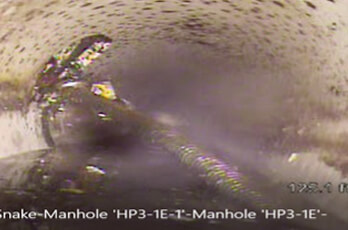
Cable protruding out of service line tap into mainline.